Product Features
- AAC construction
- Fits most 1.20-size airplanes
- APC 16 X8 prop at 9,600rpm on 15% fuel
Saito's FA-180 engine is fast becoming the pilots choice for powering
1.20 size airplanes. The FA-180 offers a 20% displacement increase over
the popular Saito FA-150. What does this mean? How about a 8% power
increase over the FA-150 and an awesome 14% power increase over the
FA-120. And what’s more the FA-180 fits in the 1.20 size mount. So if
your old 1.20 just doesn’t have what it takes, replacing it with the
Saito FA-180 is no problem. Simply put the FA-180 is the most powerful
in its class.
”With the 180 we could hover the 13-3/8 pound Stick at just under
half throttle then, punching to full, the Stick would blast off like a
rocket and accelerate to approximately 50 mph straight up in just a few
short seconds! We could do multiple vertical snaps with the Cap, then
pull out on the vertical up-line and accelerate straight up.”
J. Adams
Horizon R&D Department
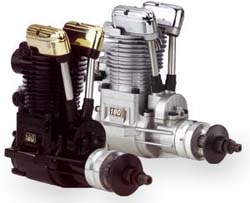
Saito’s 1.8 cu. in. four-stroke, the FA-180, is based on their
popular and powerful FA-150. The new FA-180 is the largest displacement
four-stroke single that will fit popular 1.20 size aircraft. The FA-180
has the same mounting dimensions and mounting hole-to-prop washer length
as their 1.20 and 1.50 with only the head and valve covers being
slightly raised an additional 2mm, so it will mount right in most 1.20
size airplane applications. At 31 ounces, the total weight of the 180 is
just an ounce more than Saito’s 150 with mufflers.
To achieve the additional 20% displacement, Saito has increased both
the stroke 1mm (to 28.6mms) and the bore 2mm (to 36mm) over the 1.50. To
feed this overgrown giant, the carb bore has been increased to 12mm and
the internal openings in the exhaust have been enlarged considerably for
freer breathing. And, like other Saito engines, the 180 is available in
the standard natural finish or as a GK (Golden Knight) version with a
high gloss black case and gold valve covers.
On the bench we were anxious to test the FA-180 and compare it to the
many Saito 150s that we had been flying. On 15% fuel with an APC 16x8
prop we recorded a 500 rpm increase with the 180 over the 150, with the
180 peaking out at 9,400 rpms.
For performance models, our staff has been using 30% helicopter fuel
in the larger four-strokes for years, and we’ve found many pilots around
the country who do the same. The engines run great on this fuel with no
overheating issues, plus the power gain is significant. In flight, this
fuel runs great and is easy to tune, giving a good transition. On 30%
heli fuel, the Saito 180 turns the APC 16x8 prop at 9800 rpms — that’s
400 rpms more than with the 15% fuel.
The 180 is proving itself to be a reliable performer and easy
starter. And, unlike many other four-strokes, it doesn’t seem to be too
critical of the choice of plugs. We’ve tested Hangar 9’s four-stroke
plug, K&B’s four-stroke plug and O.S. F plugs, and we couldn’t tell the
difference in idle, transition or top- end performance.
We did notice the 180 is a bit more thirsty — it consumed the 16 oz.
tank in just 9 minutes at high throttle settings. If you want to fly
longer, a bigger tank is advised.
Type: 4-stroke
Displacement: 1.80 cu in
Bore: 1.41 in
Stroke: 1.12 in
Cylinders: one-piece AAC
Engine (Only) Weight: 31 oz
Crankshaft Threads: M8 x 1.25mm
Benchmark Prop: 16x8 APC = 9,400
Prop Range: 14x13.5, 15x8 - 18x6
RPM Range: 2,000 - 10,000
Cylinder Type: AAC
|