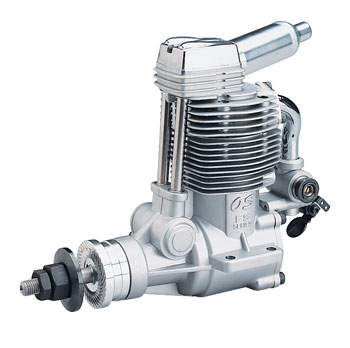
This is one of the O.S. Surpass series of 4-stroke model engines.
The Surpass series is the 2nd series of 4-stroke engines (The 1st series was
the FS series, discontinued and replaced by the Surpass series around 1986-7).
"Surpass" refers to the fact that this series gained 30% more power than the
previous FS series.
FEATURES: 30% larger intake valves than the FS series Ringed
Piston Rear-mounted updraft carburetor Helix Gear-Driven Camshaft
Ball Bearing-Supported Camshaft and Crankshaft Covered under 2-YEAR
WARRANTY.
INCLUDES: One Assembled FS-120 Surpass w/Carb and No Pump One #F
Glow Plug One Exhaust Header One Exhaust Muffler One Choke Valve
Extension One Set of Instructions, Poster, and Decals (Wrenches,
Choke Valve Extension, and Mounting Template Are No Longer Included
per O.S.)
REQUIRES: Fuel: 5%-15% nitromethane with 18% lubricant.
Synthetic, castor, or a synthetic/castor blend may be used. NOTE:
Certain four-cycle fuels cannot be used due to low oil content.
However, SOME four-cycle fuels such as the Wildcat 4-Cycle 15%
(CATP9109) may be used because it has 18% oil content. When choosing
fuels for this engine, the modeler must be sure to select a fuel
with at least a 18% lubricant content. Starting and Field Equipment.
Propeller (see SPECS)
SPECS: Bore: 30.4mm (1.22") Stroke: 27.5mm (1.08") Power Output:
1.9 BHP at 11,000 rpm Weight-Without Muffler: 30.5oz (864g)
Weight-With Muffler: 33.3oz (944g) Practical rpm Range: 2,000 -
11,000 rpm Crankshaft Thread Size: 5/16-24 Valve Clearance: Between
.04mm and .1mm (or between .0015" and .004", measured between the
valve tip and rocker arm) Length: 104mm (4.09") from backplate to
the front of drive washer Width: 47mm (1.85") width of engine
neglecting the mounting flanges 58mm (2.28") distance between the
mounting hole centers Height: 138.5mm (5.45") Suggested Prop(s):
13X11, 13X12, 14X10, 14X11, 15X8, 16X6, 16X7, 17X6 Construction:
Aluminum and Aluminum alloys
COMMENTS: Some differences between 4-Stroke and 2-Stroke engines.
4-strokes are quieter. 4-strokes get better fuel economy. 2-strokes
generate more RPM (11,000-13,000 rpm with prop while 4-strokes rev
to around 9,500 RPM) 4-strokes generate much more torque and will
swing a larger prop. 4-strokes have a realistic sound, like a real
aircraft engine. |